Picture a day like this review – Benjamin’s little operatic gem

Brevity is not a word often used when discussing opera. George Benjamin and Martin Crimp’s latest work for the stage comes in at 65 minutes, however, and while it’s short, it still manages to pack an enormous theatrical punch. This is thanks to Benjamin’s skill as a composer, and Crimp’s as a librettist. Neither a note nor word is superfluous in Picture a day like this, which received its world premiere at this year’s Festival d’Aix-en-Provence to considerable acclaim. This piece sees the pair return to the format of their first triumph, Into the Little Hill (a re-imagining of the Pied Piper tale), and is exquisitely scored for a chamber orchestra, made up of soloists from The Royal Opera House Orchestra, and five singers.
The opera charts the emotional journey of a woman following the death of her baby. She refuses to allow its body to be cremated, and instead grasps the chance of a miracle that’s offered to her that will bring her baby back to life. The task? To find someone who is genuinely happy, take a button from their sleeve, and her baby will live again. She’s handed a list containing the names of a set of individuals who could genuinely be happy, and embarks on her quest.
To her dismay, those on the list who initially appear to be happy, are in fact not. On her pilgrimage she comes across a pair of lovers, an artisan, a composer, an art collector, but during these encounters, their stories unravel, cracks appear in the surfaces and it emerges that they’re far from happy. It’s only in the concluding scene, where she meets a woman, Zabelle, not too unlike herself, does she realise what the Universe actually has in store for her.
“…while it’s short, it still manages to pack an enormous theatrical punch”
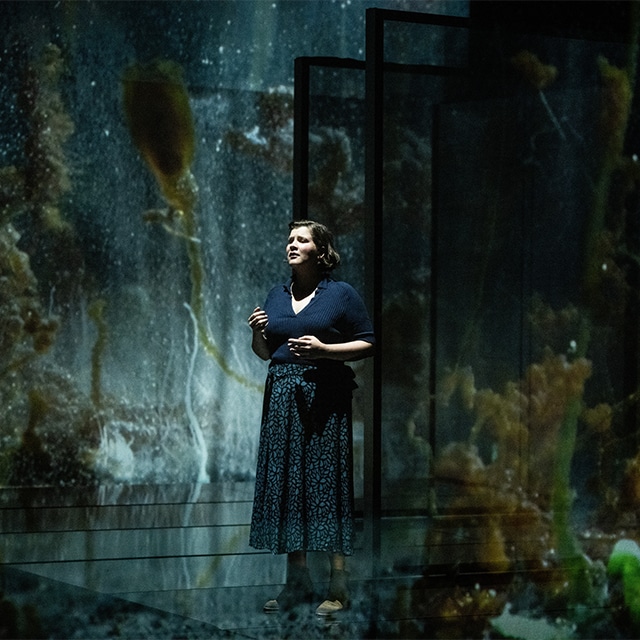
The opera exudes a dream-like quality which pervades every scene, and in turn raises many questions. Is what we’re witnessing actually happening, or is it a figment of the woman’s imagination? That’s left to us, the audience, to answer, but given Benjamin’s economic, trance-like score, maybe we’re supposed to lean towards the latter conclusion. Conjuring up a myriad palette of orchestral colours, Benjamin’s score beguiles and dazzles in equal measure.
He also creates vivid, memorable vocal lines that intertwine effortlessly with the seductive score, which are indicative of his innate understanding of how to write for the voice. New to the cast, following its French premiere, is Ema Nikolovska as the Woman. Her magnetic stage presence, allied to a warm, sumptuous tone cements her pivotal position within the drama. Also new is soprano Jaquelyn Stuker as the enigmatic Zabelle, who fills Benjamin’s soaring vocal lines with thrilling precision.
Beate Mordal, (one of the Lovers and the Composer), Cameron Shahbazi (the other Lover and Composer’s Assistant) and John Brancy (the Artisan and Collector) reprise their roles from the premiere, and all sing magnificently, clearly delineating each of the characters they portray. In the pit, conductor Corinna Niemeyer magically brings this trance-like work to life, while the playing is beyond reproach.
Daniel Jeanneteau and Marie-Christine Soma’s staging is simple, yet hugely effective, and tells the story with the utmost clarity. Maybe the projections in the concluding scene were more ‘Little Mermaid’ than a ‘garden of great beauty and tranquillity’ but even this slight visual misstep couldn’t detract from such an engrossing and illuminating afternoon of music theatre.