Lessons in Love and Violence review – George Benjamin’s opera still a masterpiece

Having seen George Benjamin’s Lessons in Love and Violence twice when it premiered at Covent Garden in 2018, I came away convinced that it was a modern masterpiece. Nothing I heard at the Queen Elizabeth Hall eight years later, in this semi-staged performance by the London Philharmonic Orchestra under Edward Gardner, gave me cause to revise that opinion. If anything, it’s an even finer work than I remembered.
Things didn’t get off to the best of starts. A technical hitch involving the lights on the orchestral players’ music stands delayed proceedings by some 15 minutes, and looking at the number of musicians assembled on the QEH stage, I did wonder whether the singers might benefit from a little amplification. I needn’t have worried. Such was the sensitivity of Gardner’s conducting that there were no issues with balance.
One of the joys of revisiting the work, particularly with the orchestra on stage rather than in the pit, was discovering just how inventive Benjamin’s orchestration is. With much contemporary opera, one finds oneself playing a game of spot the composer – a bit of Britten here, a touch of Berg there – but what struck me on this occasion was how individual Benjamin’s musical language is. The sounds he conjures up from the orchestra are endlessly fascinating, yet there’s nothing gratuitous about the writing. Everything is there for a reason, whether to serve the drama or support the singers. The opera lasts just under 90 minutes and there isn’t a superfluous note in the entire score.

Much of the work’s success is also down to Martin Crimp’s excellent libretto. Drawing on the reign of Edward II and Christopher Marlowe’s play about him, Crimp manages to pack an extraordinary amount of drama into seven relatively short scenes. The King’s love for Gaveston may be the catalyst for much of what happens, but it’s the education of his son, and what he learns about love and the exercise of power from the adults around him, that gives the opera’s title particular resonance.
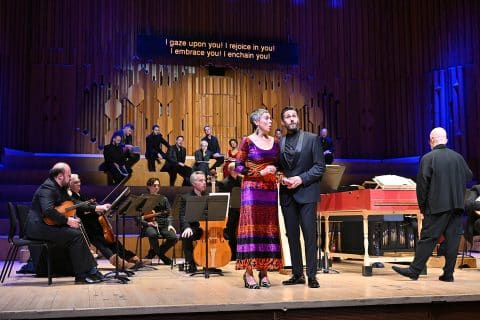
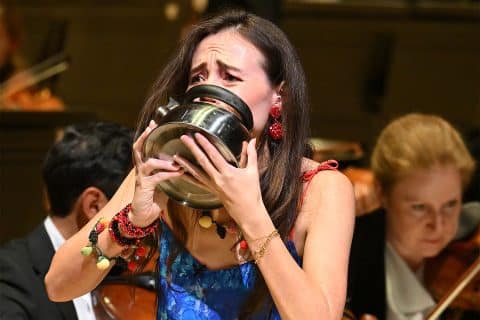
Anyone who thinks a concert performance of an opera necessarily means a compromise on the dramatic front would have been hard pressed to argue their case here. Director Dan Ayling had little at his disposal in the way of theatrical trappings – a crown atop a red velvet cushion was the sole prop – but with all eight singers performing from memory and making their entrances and exits as required, there was little sense of being short-changed.
It would be difficult to imagine a better cast. There was plenty of chemistry between Nathaniel Sullivan’s King and John Brancy‘s Gaveston, something that’s absolutely crucial if the opera is to work dramatically. Sullivan, who sang the role in the American premiere at Tanglewood in 2022, was superb, while Brancy, a replacement for the originally announced Gaveston, scored something of a personal triumph. Fresh from his acclaimed performances in the title role of Eugene Onegin at Opera North, the young American baritone is clearly a major talent. He was every bit as impressive when he returned later in the evening as the Stranger.

Georgia Jarman, who has considerable experience singing Isabel, made light of the role’s considerable vocal demands. There’s much more to Isabel than being the King’s wronged wife, and the scenes involving her and Toby Spence‘s Mortimer were compelling. How good it was, too, to hear Spence on such fine form. James Way was excellent as the Boy, subsequently the Young King, and the chilling final scene was all the more effective for the simplicity of its staging.
There wasn’t a weak link in the cast, with Hannah Sawle, Joanne Evans and Andri Björn Róbertsson (the latter having created his roles at Covent Garden) all making telling contributions. It’s worth singling out the diction of the entire cast for praise, too. How often does one come away from an opera sung in English having barely needed to glance at the surtitles?
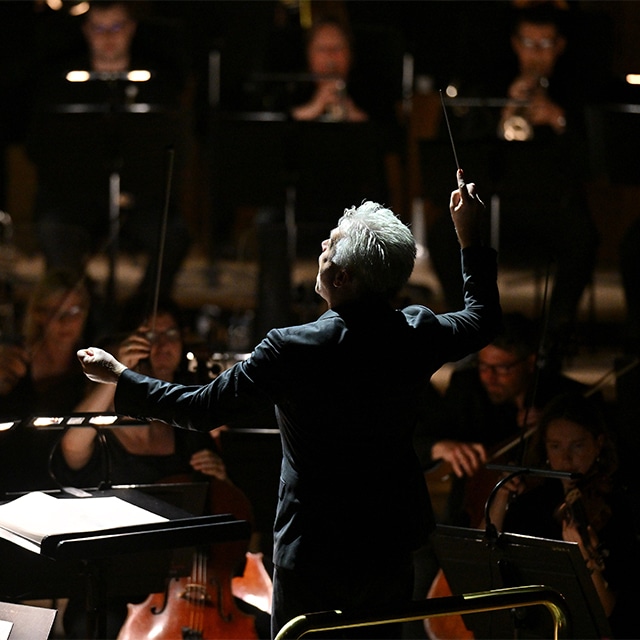
Benjamin is currently the LPO’s Composer-in-Residence, and the orchestra did him proud. The playing under Gardner was exceptional, the myriad details of Benjamin’s orchestration registering with remarkable clarity without any loss of dramatic momentum. Gardner’s grasp of the score was such that the tension never let up over the course of the evening. The prospect of hearing him conduct more of Benjamin’s operas is an enticing one.
Given the quality of the work and the reception afforded it at the QEH, let’s hope we don’t have to wait another eight years to hear it again.