Il trionfo del Tempo e del Disinganno review – the Irish Baroque Orchestra at the London Handel Festival

George Frideric Handel wrote his first oratorio Il trionfo del Tempo e del Disinganno, HWV 46a in Rome in 1707. The tale it presents may be allegorical, but the arguments the characters put forward make them feel complex and consequently real. The plot sees the figure of Beauty torn between Pleasure, who urges her to revel in her attractiveness and ultimately transitory delights, and Time and Enlightenment, who persuade her to look to God and realise that true beauty never fades because it is not about outward show. If, when stated like this, the story sounds flimsy, the issues relating to the central dilemma are debated in compelling fashion, while the oratorio feels operatic by virtue of the drama the music brings to the proceedings.
The libretto was written by Cardinal Benedetto Pamphili, who author Ruth Smith describes as ‘the best educated, most cultivated librettist Handel ever worked with’. Certainly, the multitudinous facets that he introduces to the debate make for quite a psychological piece. While we are all acquainted with the idea that beauty is only skin deep, the argument initially presented by Pleasure and Beauty that ‘to pass the hours in worrying is mere foolishness’ would also seem persuasive. Today even more than in the 18th century, we are inclined to believe that, while it is right to plan for the future, it is a mistake to be too far sighted and to miss living in the moment.
The complexities of the case are highlighted throughout as Time suggests a ‘weak beauty’ has no power over one who can make colossal statues fall, and Beauty begins to realise she must offer herself to God while she has something to give, and not when she is dying and in possession of nothing. In the quartet that ends Part I, Beauty is won over by Time and Enlightenment as she is persuaded that real pleasure resides in truth. This, however, represents a false victory as in Part II she finds that truth does not offer her comfort, and feels rather bleak. It is only when she accepts that repentance cannot be invoked at some later date, and must be shown now, that she is truly won over.
“…the Irish Baroque Orchestra… produced a balanced sound in which all of the lines were delineated clearly”

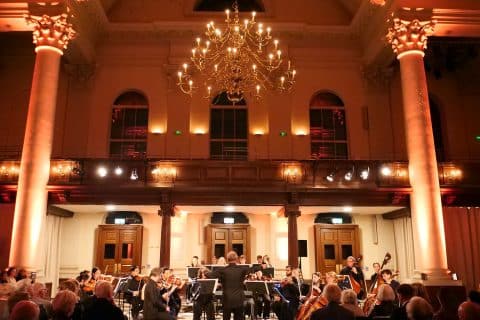
This performance at St George’s, Hanover Square constituted the first time that the Irish Baroque Orchestra had ever visited the London Handel Festival. The fifteen strong ensemble, conducted from the harpsichord by Peter Whelan, produced a balanced sound in which all of the lines were delineated clearly. The pace helped to convey the nature of the dilemmas that the characters faced. Antoine Torunczyk’s oboe solo during the Sonata dell’Overtura was able to suggest light-hearted joy and melancholic contemplation equally, but if it had been taken even a fraction faster or slower it would almost inevitably have embraced one element over the other.
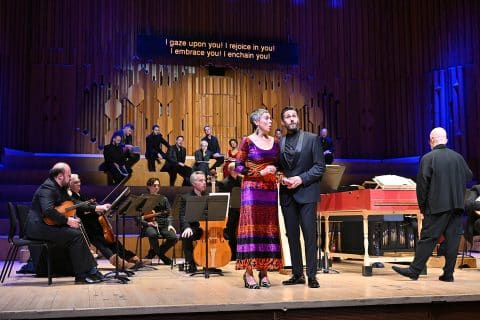
Each of the four soloists stuck to one side of the podium, both when singing in front of the orchestra and sitting ‘offstage’. Pleasure and Beauty took one side, revealing how the latter initially followed the former, and Time and Enlightenment the other. In 2018 Instruments of Time and Truth performed The Triumph of Time and Truth, HWV 71, an English language version of the oratorio produced half a century later in 1757, at King’s Place. While this saw the character of Counsel physically slam a mirror to the ground as he sang ‘Flattering mirror, thee I throw thee’, there were no similarly large gestures here and there did not need to be. One figure’s pointed glance towards another was all that was required to reveal the dynamic between them, and characters walked to the front both confidently and nervously as befitting their feelings in that moment. When Beauty finally decided in Part II to follow Time and Enlightenment she ‘crossed the floor’ to exit on their side of the stage and sit with them as opposed to Pleasure.
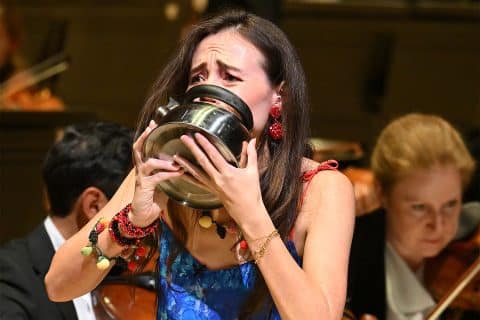
As Beauty, Rowan Pierce replaced a previously advertised Hilary Cronin at relatively short notice, but no one would ever have known. Her soprano, though strong, was soft in tone and demonstrated considerable flexibility. In the aria ‘Un pensiero nemico di pace’, which conveys two very different moods, she conquered the tricky phrasing by demonstrating superb rhythmic awareness. At the same time, she tackled the runs with great lucidity while her top lines really soared. Her sound also worked well with Helen Charlston’s mezzo-soprano in the duet ‘Il voler nel fior degl’anni’, with Pierce’s sweet soprano complementing Charlston’s weightier and nuanced voice. Charlston was decked out in a sparkling dress as befitting her character of Pleasure, and her performance of ‘Lascia la spina, cogli la rosa’, which was later to be recast as ‘Lascia ch’io pianga’ in Rinaldo, was an undoubted highlight of the evening.
Contralto Jess Dandy was a persuasive Enlightenment whose accomplished technique brought the required sense of gravitas to the character’s proclamations. If the richness and security in her sound were notable enough, her ability to produce some positively thrilling lines made her performance truly special. James Way’s tenor proved to be firm and secure on the one hand, and warm and expansive on the other. His depiction of Time was interesting as he could reveal impatience verging on anger at any idea that Beauty could defy him, but overall seemed a concerned and benevolent figure. If his portrayal of the character was multifaceted, the oratorio itself could equally be described as such, as could the whole of this inspiring and inspired performance.
• For details of all the Irish Baroque Orchestra’s recordings and upcoming events visit its website.
• The 2025 London Handel Festival continues until 18 April 2025. For details of all events and tickets visit its website.