Jephtha review – Il Pomo D’Oro present Handel’s final oratorio in the Barbican Hall

Composed in 1751, George Frideric Handel’s Jephtha is based on the story from Judges XI and George Buchanan’s 1554 play Jephthes, sive Votum. It is recognised as his final oratorio, since The Triumph of Time and Truth of 1757 represented a revision of an earlier work, and as he wrote it he was increasingly troubled by his gradual loss of sight. The story sees the Israelite Jephtha triumph in battle over the Ammonites, but then face the most dreadful situation. He had vowed that if he were victorious he would sacrifice the first living creature he saw on his return, and this turns out to be his daughter Iphis.
To make the work more acceptable to an 18th century audience, Handel’s librettist Thomas Morell modified the ending so that an Angel saves Iphis from death, declaring that she is ‘only’ required to live out her days as a virgin in the service of God. However, Jephtha still suffers the utmost agony as a result of his rash promise because the ‘reprieve’ only comes right at the end. Similarly, the final triumph is tempered by the enforced parting of Iphis from her lover Hamor that the ruling inevitably demands.
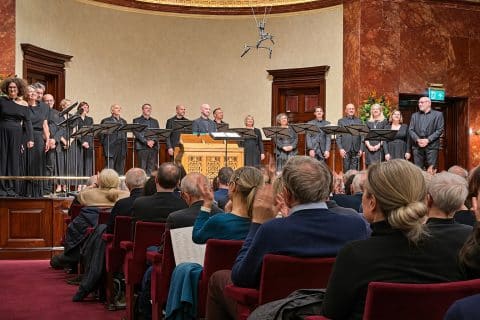
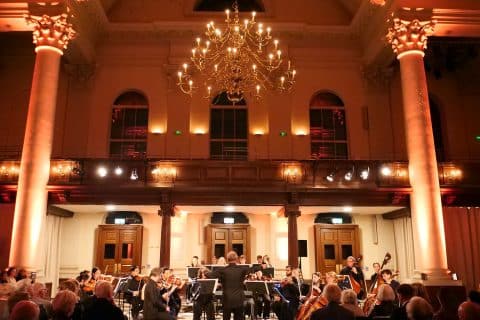
This performance from Il Pomo D’Oro was presented in a seemingly simple manner with Francesco Corti conducting from the harpsichord, the 17 strong chorus standing directly behind the orchestra, and the ‘stagecraft’ only extending to such things as flautist Marta Gawlas standing to accompany some of the arias. With music making of such a high standard nothing else was needed, as Corti elicited an exceptionally balanced sound from the orchestra that saw every transition from recitative to aria, and all of the frequent changes in mood, managed to perfection.
“With music making of such a high standard nothing else was needed…”
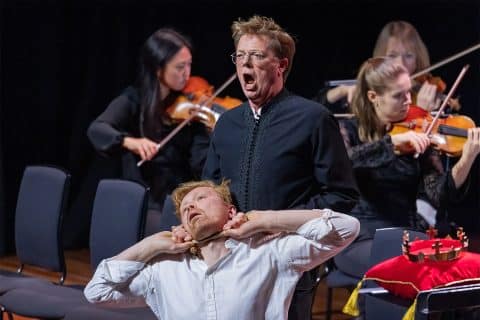
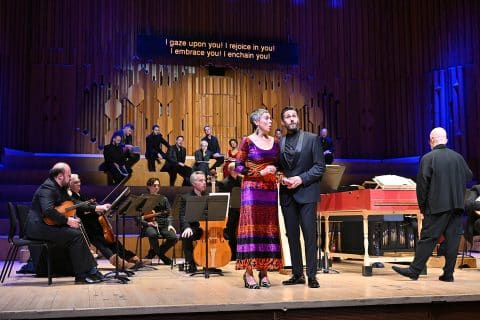
In the title role Michael Spyres gave a highly engaging performance. His upper register felt both light and expansive, which gave his whole performance an effortless feel. However, the prowess he demonstrated across his entire range was impressive, as were the various emotions he revealed. The pain he conveyed in ‘Open thy marble jaws, O tomb’ seemed very real, and contrasted markedly with the line he took in ‘Waft her, angels, through the skies’, which was beautifully touching. As Jephtha’s wife Storgé, Joyce DiDonato, whose mezzo-soprano was full of feeling, never broke character as she silently revealed her anguish before even starting her recitative ‘Some dire event hangs o’er our head’. The only difficulty with the performances of both singers was that they were so inside their characters that every time they glanced at their scores this broke the spell they had put so much effort into casting.
Cody Quattlebaum revealed a secure and compelling baritone as Jephtha’s brother Zebul, Jasmin White displayed a beguiling contralto as Hamor, while Anna Piroli delivered a beautiful performance as the Angel in ‘Happy, Iphis, shalt thou live’. Piroli also sang in the chorus, which was exceptionally accomplished as its focused sound enabled the pious gravitas in ‘Oh God, behold our sore distress’ to come across just as clearly as the gratitude and relief in ‘Theme sublime of endless praise’. While the 17 singers constituted the Chorus of Israelites, a subset of the upper voices sounded very good as the Chorus of Virgins, while a group of the men were equally persuasive as the Chorus of Priests. At the end, all of the principals joined the chorus in its line behind the orchestra to sing the closing ‘Ye house of Gilead, with one voice’.
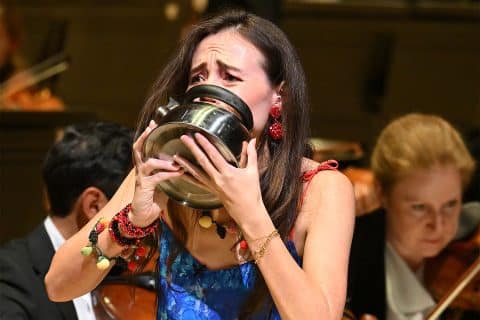
Although Spyres and DiDonato may have been the most famous names, it was another singer who came very close to stealing the show. This was Mélissa Petit who as Iphis felt more inside her part than any other performer, as her sweet soprano conveyed a strong sense of line. While her performance was technically precise, it was the nuance she brought to her sound, including the ability to instil individual notes with a sense of ‘flutter’, that made this a particularly affecting performance, and one that will live long in the memory.
• For details of all of Il Pomo D’Oro’s recordings and upcoming events visit its website.
• For details of all events at the Barbican visit its website.