Wozzeck: Wretches Like Us review – Berg’s opera meets photo-film realism at Multitudes

Alban Berg’s Wozzeck is one of the most tightly constructed and devastating works in the operatic repertoire. It does not need help. This Multitudes Festival collaboration between the London Philharmonic Orchestra (LPO) and film-maker Ilya Shagalov attempts to provide it anyway, with results that ultimately confuse more than they illuminate.
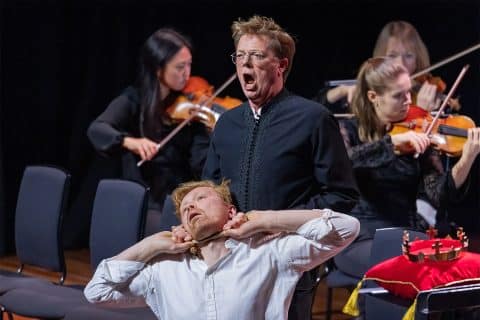
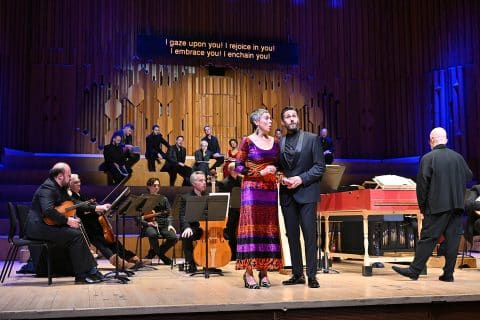
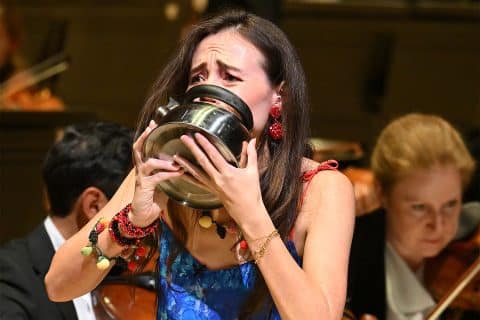
Billed as a semi-staging, this was anything but. All the singers performed with scores, entering and exiting on their musical cues with minimal interaction. The notable exception was Stéphane Degout in the title role, who remained on stage throughout. Dramatically, it rarely coalesced into anything resembling a coherent piece of theatre. For an opera that depends so completely on the cumulative force of its short, precisely structured scenes, that lack of focus was a serious problem.
Shagalov’s contribution, created with visual co-creator Nina Guseva, took the form of a continuous sequence of projected images behind the orchestra – a “photo-film” inspired by British social realism and reframing the story through the lens of a modern migrant worker. In theory, this should have sharpened the work’s social and psychological edge. In practice, it did the opposite. What we saw instead was a succession of disconnected images that often bore only the loosest relationship to the action unfolding in the music, frequently competing with the surtitles and making the drama harder, rather than easier, to follow.
At times, the effect was actively distracting. Key elements of the story were left unclear or entirely absent: when Marie sings to her child, for example, there is no visual trace of him, depriving the scene of one of its central emotional anchors. For anyone unfamiliar with the opera, the narrative must have felt frustratingly opaque – a curious outcome for a festival that aims to broaden access to classical music. One is left wondering what, exactly, such an approach is meant to achieve. If the intention is to attract new audiences, then clarity, not obfuscation, should surely be the priority.
“Dramatically, it rarely coalesced into anything resembling a coherent piece of theatre”

All of this was particularly frustrating given the sheer quality of the musical performance. Edward Gardner conducted with complete command of Berg’s volatile, fast-moving score, pacing it with a sure sense of its underlying architecture while allowing its moments of lyricism and violence to register fully. The LPO responded with playing of exceptional precision and intensity. Berg’s orchestration – by turns raw, translucent and terrifying – was realised with extraordinary clarity, every detail etched without ever losing the sweep of the whole. No praise could be too high for the way Gardner and his players delivered this magnificent score.
The cast matched that level of commitment. Degout’s Wozzeck was a compelling central presence, vocally secure and dramatically alert, his portrayal capturing both the character’s fragility and his growing sense of disintegration. Annette Dasch brought warmth and lyrical poise to Marie, while also suggesting the character’s inner conflict. Peter Hoare’s Captain was sharply characterised without tipping into caricature, and Brindley Sherratt’s Doctor combined vocal authority with an unsettling edge of cruelty.
Christopher Ventris made a forceful Drum Major, his swaggering presence cutting through the texture with ease, while Eirik Grøtvedt’s Andres provided a neatly drawn contrast. Kitty Whately’s Margret was vividly etched, and Adrian Thompson’s Fool made a strong impression in his brief but telling interventions. Callum Thorpe and Dominic Sedgwick (luxury casting) were both excellent as the Apprentices, and the contributions from London Voices and the Tiffin Boys’ Choir added further weight and atmosphere.
Taken purely on its musical terms, this was a Wozzeck of real distinction. But opera is not only about how it sounds; it is about how it communicates. Here, the visual concept repeatedly pulled focus away from the performers and the drama, never finding a convincing way to integrate with the work it sought to reinterpret. Instead of deepening the experience, it reduced it to something oddly fragmented and, at times, curiously banal – closer to a sequence of holiday snaps from the package holiday from hell than a meaningful engagement with Büchner and Berg’s bleak, unflinching vision.
Wozzeck does not need updating to feel contemporary; it already is. What it needs is space to unfold with clarity and inevitability. For all the excellence on the platform, this was a performance that too often had the rug pulled from under it, leaving a confusing and fundamentally misjudged whole.