The English Concert review – impeccable performances of Handel at Wigmore Hall

Like many Early-music ensembles, The English Concert is a variable collection of personnel, all adepts in the style in which they perform. The first half of Tuesday evening’s concert at Wigmore Hall concentrated on a smaller group: the vocal soloists Lucy Crowe (soprano) and Iestyn Davies (countertenor), two violinists Nadja Zwiener and Anna Curzon), and a colourful continuo section of two harpsichords, theorbo and cello, directed by Harry Bicket.
First cab off the rank was the Italian duet Tanti strali sen mi scocchi, written for the Hanover Court after Handel returned to northern Europe after shaping his lifelong musical style in Italy. Crowe and Davies took the vocal lines, and after a precisely measured opening instrumental section (featuring Joseph Crouch’s meltingly delicious obbligato cello) demonstrated what a perfect combination of textures their voices are for this kind of music. The busy outer sections were delivered with insouciantly accurate bounce and joy, while the suspensions in the slow central section were performed with the inexorable intensity of planetary collision. The instrumental underlay to all this was quietly brilliant, and co-ordinated for balance and orchestral colour with a consummate understanding of style.
All of this excellence returned at the end of the first half, for the lengthier Il duello amoroso, written a few years earlier during Handel’s stay in Rome. Il duello is a fairly standard Italian Baroque vocal interchange: a tale of Amarilli, a crafty, saucy shepherdess rejecting the surly advances of Daliso, her would-be shepherd lover, set to a deal of brisk recitative (full of sexual innuendo) with the occasional pause for a sighing (or angry) da capo aria, finishing in a conciliatory duet. Thanks, though, to Handel’s burgeoning compositional talent, and the first-class performance, the piece travelled beyond its origins as a bucolic trope to entertain the jaded gentry after dinner to become a sparkling little vignette. The short, busy instrumental opening (full of verve from the two violins) was given a stunning pull up into a suddenly elegant minuet, this attention, by the instruments, to mannered style, continued throughout the work, culminating in some excitingly percussive playing from theorbo, cello and harpsichord in the final duet. Crowe and Davies were faultless in their accounts – not only in tone and dynamic (and some agile co-ordination in the duet), but in communication of mood. Davies’ Daliso, a sullen bundle of adolescent frustration, was perhaps less dramatic, but the slower, more fervid delivery of, for example ‘È vanita d’un cor’ left us in no doubt of the character’s churlishness. Crowe’s voice, meticulously controlled for swift shifts of dynamic and texture – as well as some agile work on Handel’s pyrotechnic runs in ‘Quel nocchiero…’ – brought us a flashing temptress along with the occasional parlando extension of a ‘hah!’ of scorn.
“…what a perfect combination of textures their voices are for this kind of music”
Between the two vocal items, the instruments gave us an artful performance of the B-flat Trio Sonata from 1739, bringing, through some carefully studied period-authentic playing, a charming set of five movements polished for contrasting atmosphere: a dignified Larghetto, a busy Allegro, a few Adagio chords into some crisp fugal counterpoint, a jolly gavotte and a polite minuet.
Choral singers generally approach Bach with a touch of trepidation – it’s nearly always difficult – whereas Handel generally presents fewer technical challenges. Not so, though, his 1707 Dixit Dominus, a setting of Psalm 109, which was written as a piece of breathtaking exhibitionism for his patrons (and would-be patrons) in Rome. It’s full of fiendishly sharp cornerings in text, pitch, dynamic, mood and speed, and calls for a considerable amount of dexterity in both singers and players.
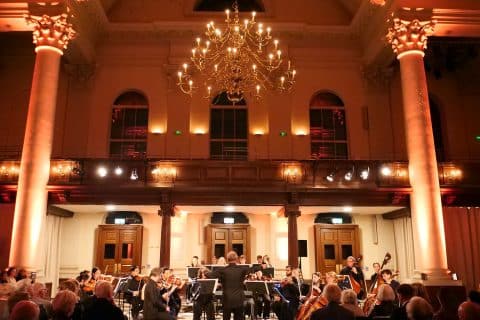
We need not have worried, however, as the augmented forces on stage (extra strings and a bassoon; the voices swelled to ten, including soprano Julia Songi, tenor James Way and bass Ashley Riches) were more than up to picking up Handel’s thrown down gauntlet. Brisk and sprightly tempi were deployed throughout (apart from the soprano duet ‘De torrente’, which was given all the slow weight it needed for those suspensions to ping out), and even the notorious tongue-twister ‘secundum ordinem Melchisedek’ came over clearly and with precision. In general, the use of just two singers to a part came over well, and certainly during the choral ‘walls of sound’, volume and blend were perfect, but there were occasional moments (the second soprano entry for ‘Judicabit’, for example) where the attack might have been more forceful. Again, the continuo section delivered some thrilling clanks and bangs to point up the text (‘Dominus a dextris tuis’ had a sensationally percussive drive to it), and the whole work, all the way through to its perilously fast yet soufflé-light ‘et in saecula saeculorum Amen’ made for an electrifying second half.