LPO review – Barber, Berlioz and Beethoven open the London Philharmonic Orchestra’s new season

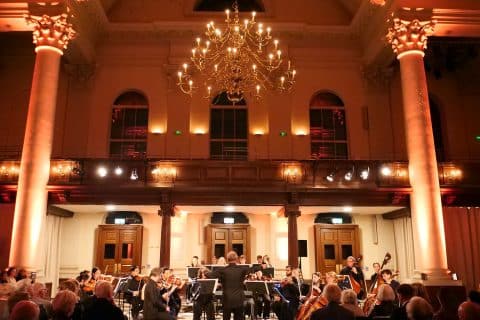
The London Philharmonic Orchestra (LPO) opened their 2024/25 season with an eclectic programme, showcasing three works by Barber, Berlioz and Beethoven, conducted with élan by their music director Edward Gardner.
The theme of the first half was death. Not, one might argue, the cheeriest way to usher in a new season. But when one of the works, Berlioz’ La mort de Cléopâtre, is programmed to showcase the formidable vocal talents of one of the world’s most exciting singers,no one was really complaining.
Opening the concert was a real rarity – Medea’s Dance of Vengeance by Barber. This was the first time the LPO had performed this work, which is extracted from the climactic moment of the composer’s ballet, Medea – commissioned by none other than the fêted American choreographer and dancer, Martha Graham. A sense of foreboding hangs in the air from the the very start – a bass drum ominously throbs under the cover of strings, punctuated by nervous chattering on the xylophone – as climaxes build and subside, before the full orchestra mirrors Medea’s fateful act of revenge in an orgy of unbridled ferocity. Gardner spurred his players on to give their all, and the overall effect was quite shattering, even if there are elements of Barber’s music that sound formulaic within this context.
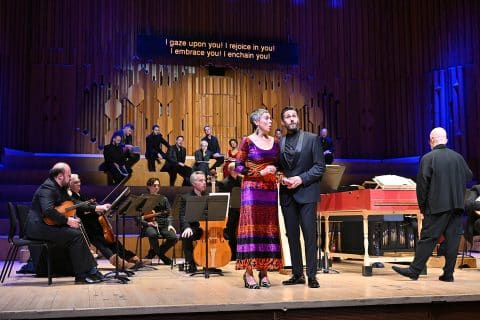
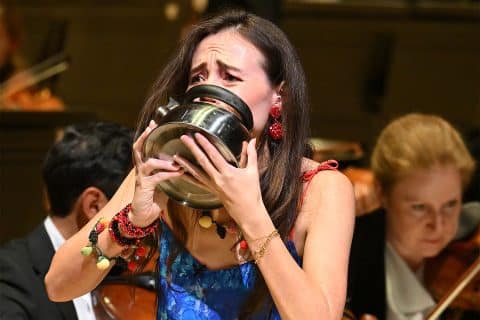
There’s certainly nothing formulaic about Berlioz’ cantata, La mort de Cléopâtre, which throughout its relatively short 20 minutes takes us on an intense, impassioned journey, as we relive the Egyptian queen’s final moments. Dressed regally in shimmering gold, our queen for the evening, DiDonato, displayed the entire gamut of of emotions Berlioz demands – despair, anguish, anger and resignation – and brought the role of the scorned Egyptian queen to vivid life, singing and acting as if her life depended on it. She was utterly spellbinding throughout.
“A sense of foreboding hangs in the air from the the very start…”

Not only was her dramatic control phenomenal – those crescendos from a barely audible whisper to to a shattering fortissimo were faultlessly etched, but her phrasing, colouring of Berlioz’ vocal lines, and idiomatic French all combined to make this as thrilling an interpretation as you’re likely to hear. Imperious in her indignation, ‘Et la fille des Ptolémées, A subi l’affront des refus (And the daughter of the Ptolemies has suffered the insult of being rejected), turning to wistfulness as she remembered better times, ‘Ah! Qu’ils sont loin ces jours, tourment de ma mémoire (Ah! How distant are those days, the torment of my memory), her ability to switch between such conflicting emotions in the blink of an eye was quite extraordinary.
The LPO certainly stepped up to the plate, matching DiDonato’s impassioned performance note for note – the still, repetitive notes on the double basses, which represent Cléopâtre’s faltering heartbeat as the asp’s poison seeps into her veins, chilled the blood. DiDonato is a remarkable artist – here at the absolute top of her game – and was rightly rewarded with a thunderous ovation at the close.
After the interval we were treated to a vigorous performance of Beethoven’s Symphony No. 3 – the Eroica. It’s not unusual these days for orchestras playing on modern instruments to pursue a hybrid approach, usually replacing the horns, trumpets, and timpani with original instruments. Crooked horns, valveless trumpets, and hard-hit timps add a period tang to the orchestral sound, providing a sense of frisson that their modern counterparts don’t possess. Gardner’s approach was best described as hybrid-hybrid, as he opted for period trumpets and timpani, but modern horns. In addition, the strings played with vibrato, so the overall effect was somewhat discombobulating.
There was much to admire, however, as Gardner certainly kept the orchestra on their toes, as the symphony sped along at a cracking pace. There was plenty of exquisite woodwind playing in the second movement, while those tricky horn calls in the Scherzo were dispatched with consummate ease. The final movement had terrific drive, those period trumpets and timps certainly coming into their own here.
All in all, this was an auspicious start to the LPO’s new season. DiDonato’s mesmerising portrayal of Cléopâtre, and Gardner’s accomplished conducting combined to create an evening of music making that will linger long in the memory.
• Details of upcoming events at the Southbank Centre can be found here.