Death and Transfiguration – Strauss, Ravel and León from LPO and Canellakis

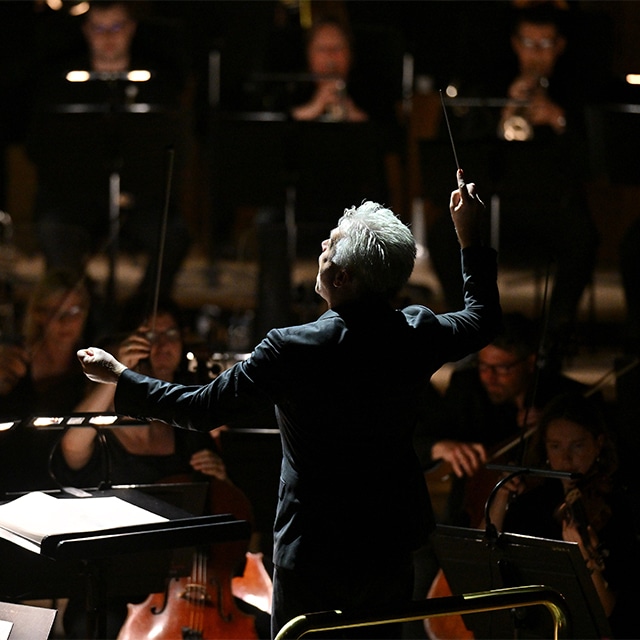
Despite Strauss’ assertion that his style was entirely sui generis, one can hear, in his early works, the influence of composers such as Wagner, and, certainly, his 1888 tone poem Don Juan has touches of Wagner’s ‘Romantic’ pre-Ring writing about it: there are echoes of, say, Tannhäuser not only in its passages of brassy bravura, but in the quieter, more lyrical ‘love themes’. The London Philharmonic Orchestra under the expansive yet precise direction of Karina Canellakis brought all this to the party from the opening grandiloquent flourish of the work through to its dramatic ‘fade to black’ close. Swash there was aplenty, and buckle too, from some solid work in the brass and throaty horns (if there ain’t French horns, it ain’t Strauss). Plenty of attention, though, was given to the subtler material: the quiet agility of the cellos in their moment of glory, for example, was impressive; the first, flute-initiated love theme was allowed all the breadth it needed, with fine dynamic control of the underlay; the hush that greeted the oboe solo for the second love theme was magical.
The other end of the concert saw a first-rate performance of Death and Transfiguration, Strauss’ tone poem from a year later. This is a different beast entirely, and while it has touches of Mahler’s unfulfilled yearning in its chromaticism, this is probably more down to Zeitgeist than influence, as its creation was contemporaneous with the latter composer’s second symphony. Here, the orchestra responded to Strauss’ meticulous delineation of mood with every bit of nuance at their disposal. The opening passage on just a few strings was as quiet and gentle as you’d want, and the subsequent colouring from bassoon and contra-bassoon was painted in the palest watercolours. A precisely controlled slow build allowed the woodwind solos to pierce the warm tone of full strings with an almost palpable ache, and the eventual explosion of the Allegro was well judged for dramatic effect. Although Canellakis let the orchestra off its leash for the fortissimo moments, that sense of firm control pervaded, such that the lilting rocking of the little love theme contrasted well with the stirring appearances of Strauss’ much used ‘artistic idealism’ theme, whose last iteration, after ‘the gong of death’ was bathed in the golden sunshine of a brilliantly judged orchestral warmth.
“Swash there was aplenty, and buckle too…”
Wednesday’s concert marked the launch of the Cuban composer Tania León as LPO’s Composer in Residence, and a number of her works (including a new commission) will be performed over the coming season. The first of these, her 1999 short work Horizons was given its UK première. Its form and substance certainly reflect León’s early immersion in 20th century American Modernism: this is a work of textures and sonorities rather than lush harmony or lyricism. Its constant stuttering drive shifts across the orchestral sections, and is pervaded by brief swirls or short, diaphanous chords from strings, furious percussion interludes, blotchy trumpet fanfares, woodwind squeaks, low brass flatulence and glissandi from harp and piano. It’s an interesting work, and while the orchestra turned in a performance of clarity and thoroughness that made for an appropriately astringent palate cleanser amid all the lushness of the other works, one was left feeling that 10 minutes was probably enough.
The loss of Paul Wittgenstein’s right arm in the Great War occasioned the pianist to commission works for the left hand only from a number of composers, including Korngold, Britten, Prokofiev, and Hindemith. We rarely hear, say, Britten’s Diversions for Piano Left Hand and Orchestra or Karl Weigl’s Piano Concerto for the Left Hand; Prokofiev’s fourth concerto gets the occasional outing, but by far the most popular of Wittgenstein’s commissions is Ravel’s Concerto for the Left Hand. This may be because it’s such an immediately appealing work: full of rhythm and lyricism by turns, and, at the same time as being complex enough to sound as though two hands are playing, it clearly highlights all the techniques that often fall to the left hand in more staid works.
The orchestra was joined by French pianist Cédric Tiberghien for the piece, which was given a generally excellent account. The opening rumble in the low strings was appropriately impressionistic, and the short passage for contrabassoon that arises from it was gloriously lugubrious. Perhaps, though, the subsequent build to a climax before the piano entry might have been given a touch more oomph at its apogee. Tiberghien, playing from memory, brought buckets of sensitivity and understanding to the piano part (albeit that his initial grand leap, while powerful, was not as keyboard bending as some performances), and the lengthy cadenza towards the end of the work was peerlessly executed. One sensed, at times, perhaps a little too much holding back in the orchestra – Ravel’s garish brass passages were occasionally a trifle muted – but the woodwind textures (full of the same sort of jazz influenced slides as the composer’s earlier Boléro) came across well, and the excitingly accentuated performance of the Allegro section felt as though its heavy tread – through the iron control of dynamic and the exactitude of the percussion – had been amplified with hobnailed boots.
Tiberghien’s encore, an effortlessly fluid rendering of Debussy’s Feux d’artifice confirmed – if any confirmation were needed – his peerless technique.