LPO review – Edward Gardner conducts Ravel at the Royal Festival Hall

It’s not every day you see an acrobat dangling from a rope while Ravel’s shimmering score unfolds beneath them. But that was exactly the kind of theatrical sleight of hand at play in the London Philharmonic Orchestra’s (LPO) bold opener to the Southbank Centre’s Multitudes Festival. This world premiere collaboration between the LPO and Australian circus troupe Circa, directed and lit by Yaron Lifschitz, paired two of Ravel’s most luscious works – Daphnis et Chloé and La valse – with Circa’s physical storytelling. The result was equal parts striking, stirring and occasionally confounding.
There are many ways to stage Daphnis et Chloé, but this was certainly a first for me. Gone were the nymphs and shepherds of its original Ballets Russes incarnation. In their place: a human jungle gym of torsos, limbs and trust falls, delivered with Circa’s trademark intensity. The company’s ten performers moved with extraordinary grace and control, sometimes mirroring the music, sometimes pulling against it. A duet of entwined bodies unfolded as a dreamy counterpoint to Ravel’s choral haze; later, more frenetic episodes sparked physical tableaux that verged on the chaotic.
There was no attempt at narrative clarity, and that was part of the point. Lifschitz’ direction is fluid, abstract, and deliberately open-ended. At times it felt less like choreography and more like weather: something atmospheric and unpredictable, drifting across the music. You could read into it a story of intimacy and rupture, of community and collapse – or you could simply enjoy the physical spectacle. Either way, the presence of bodies in motion, so close to the orchestra, lent the performance a heightened sense of immediacy and risk.
What was most impressive was how well the circus troupe melded with the music. Lifschitz wisely avoids literalism – there’s no attempt to match every musical cue with a trick – instead, he lets mood and movement sit in dynamic tension. That made for some breath-taking moments, particularly in the final Danse générale, where the stage erupted in a whirling vortex of motion that felt both climactic and cleansing.
“…striking, stirring and occasionally confounding”

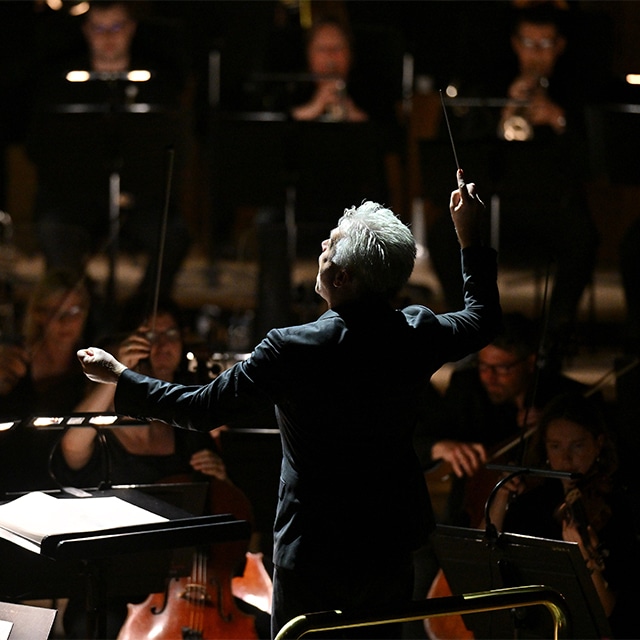
Edward Gardner, in galvanising form on the podium, brought an expansive lyricism to the score, shaping its pastel textures with care. He knows how to give this music space to breathe without ever losing forward momentum. The BBC Singers added a silvery sheen to the orchestral sound, their wordless chorus interjections providing an ethereal quality to the proceedings. The LPO, on magnificent form, navigated the score’s myriad challenges with apparent ease – the sinuous wind solos and radiant string writing handled with finesse and confidence.
La valse, which followed immediately without a break, served as a kind of coda to Daphnis et Chloé – less a second half than a dark, dissonant afterthought. Ravel’s decadent orchestral fever dream became a grotesque waltz of fragmented duets and dizzying lifts, bodies spinning like dancers caught in a dying empire. If Daphnis conjured nature and sensuality, La valse was its opposite: dissolution, decay, collapse. Lifschitz’ lighting turned colder, shadows deepened, and the performers became ghostly wraiths, clinging to each other as the music unravelled.
Here, too, the circus vocabulary resisted obvious interpretation. The waltz rhythms emerged distorted, the bodies disjointed, as if Ravel’s world was being shaken apart from the inside. The tension between form and freedom, structure and chaos, became a kind of commentary in itself. It was hypnotic, if not always coherent.
It didn’t all land. There were moments where the circus action threatened to overwhelm the music, or where the connection between movement and sound felt tenuous. And while the audience was clearly captivated – there were plenty of audible gasps – a few tweaks to pacing and clarity wouldn’t go amiss. Occasionally, the sheer amount of activity on stage made it difficult to know where to look, or what to feel.
Still, there’s no denying the ambition here. This was a daring reimagining of a much-loved orchestral showpiece, and one that largely succeeded on its own terms. Circa’s raw physicality brought fresh immediacy to Ravel’s music, while Gardner and the LPO ensured Ravel’s glittering, sumptuous score was never overshadowed.