LPO/Gardner review – a profoundly moving War Requiem opens the new season at the RFH

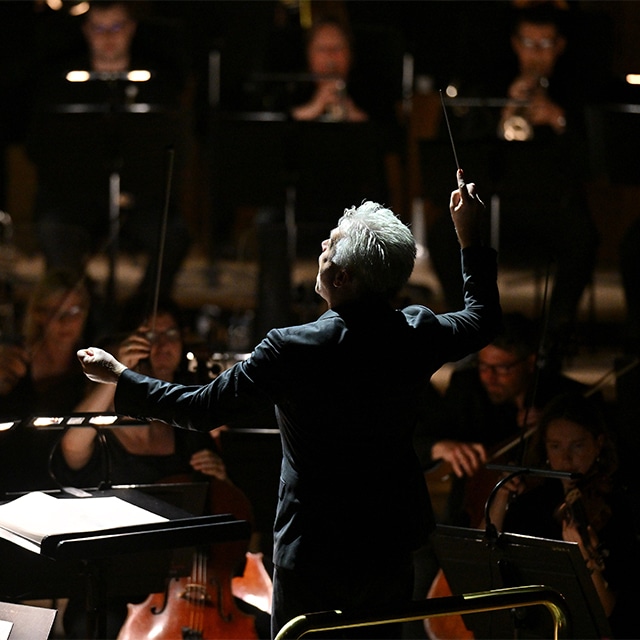
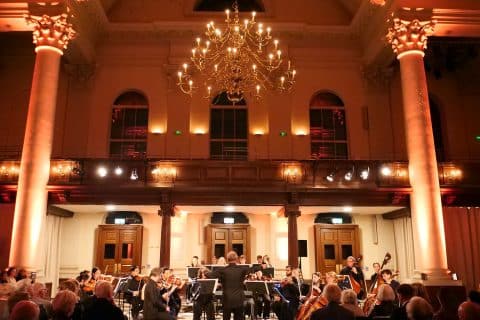
There could hardly have been a more appropriate work with which to launch the London Philharmonic Orchestra‘s 2026-27 season, entitled ‘In Search of Purpose‘, than Benjamin Britten’s War Requiem. Written for the consecration of the new Coventry Cathedral in 1962, Britten’s monumental anti-war statement has lost none of its power or relevance. With Edward Gardner conducting the LPO and an impressive array of choral forces, this was a performance that combined tremendous musical discipline with emotional impact.
Gardner marshalled his vast forces admirably, maintaining momentum throughout the work’s six movements without allowing its more reflective passages to lose their intensity. There was certainly no sense of lingering unnecessarily, and the playing of both the main orchestra and the separate chamber ensemble was beyond reproach. Britten’s ingenious juxtaposition of the Latin Mass for the Dead with Wilfred Owen’s devastating war poetry emerged with remarkable clarity.
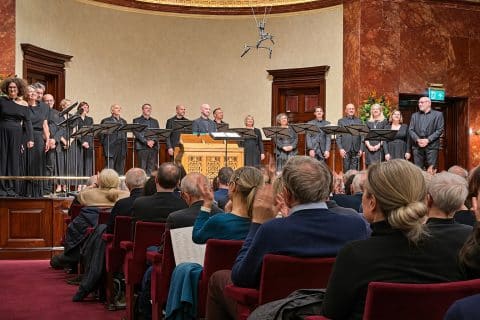
The combined London Philharmonic Choir, prepared by Madeleine Venner, and London Symphony Chorus, under Mariana Rosas, delivered singing of exceptional discipline and homogeneity. Every dynamic marking seemed meticulously observed, from the quietest pianissimos through carefully controlled crescendos to the overwhelming climaxes of the Dies irae and Libera me. Equally impressive were the Tiffin Boys’ Choir and Girls’ Choir, directed by James Day, whose ethereal contributions from the rear balcony provided a mesmerising contrast to the formidable forces assembled on stage.
The evening’s revelation, however, was American tenor Paul Appleby, who stepped in at short notice for an indisposed Allan Clayton. His performance was magnificent. Possessing faultless diction and an instinctive understanding of the text, Appleby brought an extraordinary sense of loss and humanity to Britten’s inventive settings of Owen’s poetry. There was nothing exaggerated about his delivery; the words and music were allowed to speak for themselves, making their impact all the more powerful.

Benjamin Appl proved an equally sensitive interpreter, bringing a Lieder singer’s intuitive understanding of words and phrasing to his contributions. His wonderfully rich baritone was a pleasure to hear, although there were moments when a little more vocal heft would have been welcome, most noticeably in the declamatory setting of ‘On Seeing a Piece of Our Artillery Brought into Action‘. Nevertheless, his partnership with Appleby was exceptional. Their voices blended beautifully in ‘The Parable of the Old Man and the Young‘, while their account of ‘Strange Meeting’ was almost unbearably moving.
Natalya Romaniw completed an impressive trio of soloists. Her powerful soprano possessed more than enough steel to ride the orchestral tumult, yet she was equally capable of producing singing of exquisite beauty. Her singing in the Lacrimosa was achingly beautiful, all the more remarkable given the sheer power she had unleashed elsewhere.

Ultimately, it was Gardner’s ability to bring these disparate musical forces together that made the evening so memorable. The final Libera me was overwhelming, but it was the transition into ‘Let us sleep now‘ that provided the performance’s emotional climax. Gardner and his musicians achieved it faultlessly, allowing Britten’s extraordinary vision of shared humanity to unfold with devastating simplicity. As the final, barely audible Amen faded, the audience remained motionless. Nobody dared breathe, let alone applaud. When the silence was finally broken, the performers were greeted with a huge and thoroughly deserved ovation. This was an evening of tremendous musical and emotional power, and a compelling reminder that Britten’s masterpiece remains as potent today as it was at its premiere in 1962.