London Philharmonic Orchestra review – Víkingur Ólafsson mesmerises a packed Royal Festival Hall

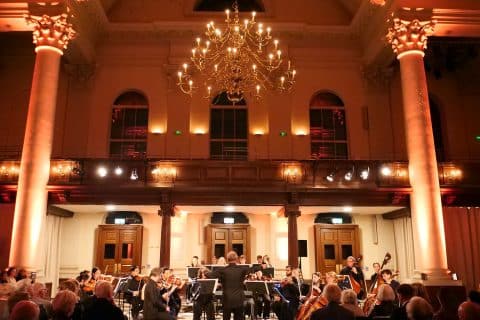
Before embarking on an extensive tour of Germany one of the hottest keyboard properties in the musical firmament right now, Víkingur Ólafsson, gave Londoners a taste of what the Germans have in store – and it captivated a packed Royal Festival Hall.
Ólafsson’s playing was outstanding – it’s just a shame that the work in question, Brahms’ meandering, overblown, overlong early work, was chosen as the vehicle for him to display his prestigious keyboard wizardry. At the risk of incurring the ire of the German composer’s fans, there’s no escaping the fact that this – his first major orchestral score – is a piece in which the young composer is tentatively finding his feet.
There aren’t enough musical ideas to hold the attention for its 45 minute span, nor does it really offer the soloist enough moments of bravado, where they can really show off their technique and dexterity. Having said that, it’s hard to imagine a more detailed, loving, or technically assured performance than the one offered by Ólafsson on this occasion.
“Ólafsson’s playing was outstanding…”

In the first movement, marked Maestro, Ólafsson found the right amount of weight and colour, matching the orchestra note for note – those runs and arpeggios were crisply articulated, and there was a sense of pensiveness that pervaded the cadenza. Ólafsson swapped bravura for a more introspective approach in the Adagio, delicately caressing the keys while phrasing impeccably before throwing himself into the Rondo with abandon, yet still retaining clean, precise articulation – nothing ever sounded smudged. Conductor Edward Gardner and his players supported him well, although opting for a relatively large string section, which included six double basses, occasionally led to some balance issues, particularly in the second movement. Ólafsson never disappoints, and his standing as one of today’s finest pianists was further enhanced by his exemplary playing on this occasion. For an encore he gave an introspective, almost fragile rendition of Kaldalons’ Ave Maria in his own arrangement.
It was quite clear after the interval that Ólafsson was the main draw, as the audience had noticeably thinned out. There were two works in the second half – the world premiere of Freya Waley-Cohen’s Mother Tongue, and Bartók’s The Miraculous Mandarin Suite – and those who left certainly missed out. Waley-Cohen’s 25 minute work can best be described as post-minimal. She deploys blocks of textures, which she then goes on to develop thematically – those blocks being assigned to specific sections of the orchestra. At times, though, it was hard to follow the musical narrative, and the influence of other works, especially The Rite of Spring was never far away. There were some flashes of brilliance, but also some clichéd moments, but Waley-Cohen certainly knows how to write for a large orchestra and has a keen ear for orchestral colours. The playing of the LPO was beyond reproach.
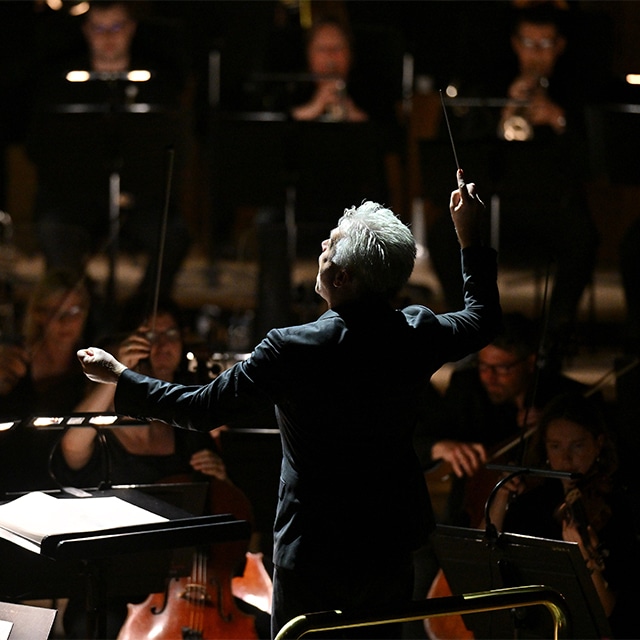
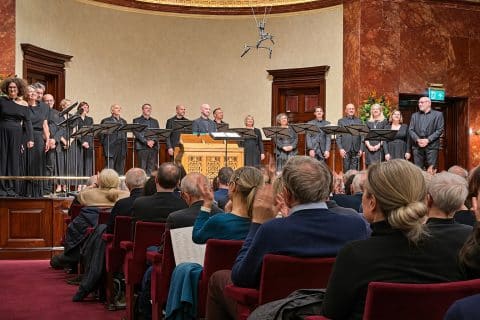
In many ways they saved the best for last, as Gardner and all sections of the orchestra pulled out all the stops for a viscerally exciting performance of Bartók’s thrilling score. This was a no holds barred interpretation that was quite simply electrifying and full of energy, its complex, pounding rhythms on point, while the precision of the playing was breathtaking, with the seven percussionists in particular giving their all. It’s hard to imagine a more exhilarating way to close the evening than this exemplary performance, and given the audience’s huge ovation, they obviously thought so too.