London Philharmonic Orchestra review – Edward Gardner conducts Sawer, Britten and Berlioz

Wednesday’s London Philharmonic Orchestra (LPO) concert, a continuation of their Moments Remembered season, at the Royal Festival Hall, under the baton of Edward Gardner, promised an evening of turbulent emotion and arresting drama: a world premiere from David Sawer, the searing brilliance of Benjamin Britten’s Violin Concerto and the unhinged theatricality of Hector Berlioz’ Symphonie Fantastique. In practice, it exceeded all expectations, delivering moments of spellbinding intensity and orchestral brilliance.
David Sawer’s Sphinx, receiving its world premiere, opened the proceedings with an exploration of layered textures and shifting perspectives. Inspired by Francis Picabia’s painting of the same name, the piece sought to evoke its subject’s enigmatic qualities through a series of fractured motifs and restless orchestral dialogue. From the outset, it was clear that Sawer has a remarkable ear for orchestral colour, his ability to manipulate sonority lending the work an almost kaleidoscopic quality. Moments of gossamer-light orchestration suddenly gave way to something much darker and more oppressive, shifting seamlessly between mystery and menace. The piece was immersive, engaging and ultimately deeply compelling – a work that intrigued and lingered in the imagination long after its final notes had faded. Gardner and the LPO gave it a commanding first performance, bringing its intricate textures to vivid life.
This was followed by the evening’s centrepiece: Britten’s Violin Concerto, performed by Augustin Hadelich, a violinist of staggering technical assurance and expressive depth. Britten’s concerto has, in recent years, rightfully taken its place as a cornerstone of the standard repertoire, its devastating emotional arc and formidable technical demands making it one of the most rewarding, and harrowing, works for the violin. Hadelich’s interpretation balanced precision with raw intensity, from the haunting lyricism of the opening to the merciless, almost manic energy of the Vivace. His ability to sustain tension was remarkable – phrases stretched to their emotional limits yet never tipping into excess, always serving the work’s intricate architecture.
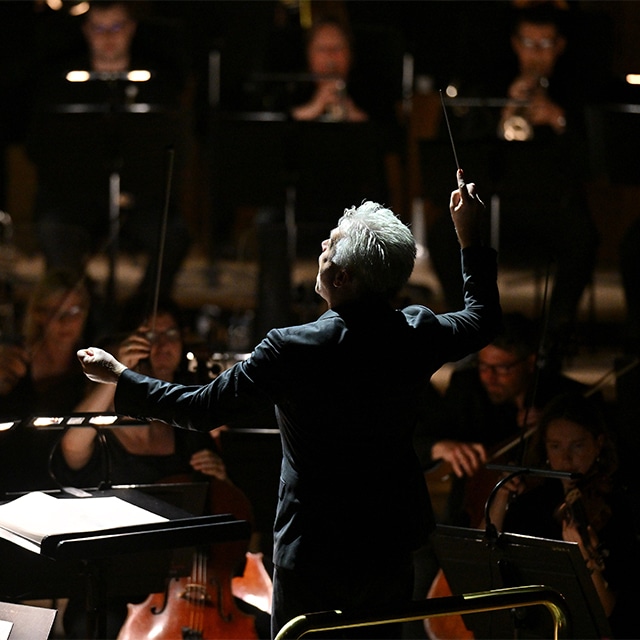
“…it exceeded all expectations, delivering moments of spellbinding intensity and orchestral brilliance”

(Photo: Marc Gascoigne)
In the final Passacaglia, Hadelich achieved something truly extraordinary. He approached the opening variation with an almost reverential delicacy, the LPO’s strings providing a gauzy, ethereal cushion beneath him. But as the movement unfolded, that restraint gradually fractured into something altogether more anguished. The high-lying melodic lines, fragile yet insistent, seemed to hover between resignation and outright despair. And when the final unresolved chord dissolved into silence, it somehow refused to release its grip. Gardner and the orchestra provided an expertly judged accompaniment, never overwhelming the soloist, yet ensuring that Britten’s orchestral outbursts retained their full bite. It was a performance of gripping intensity, and the audience – after a moment of stunned stillness – quite rightly responded with rapturous applause. His encore, Bach’s Partita in D, enthralled.
After the interval, Berlioz’ Symphonie Fantastique brought a different kind of emotional turbulence: the fever dream of an opium-addled romantic obsessed to the point of self-destruction. Gardner, whose instinct for large-scale musical architecture is second to none, took a vivid but unsentimental approach. He kept the opening Rêveries – Passions taut, allowing the music’s nervous energy to build without ever indulging in excessive languor. The Ball whirled with graceful menace, the harps providing an eerie shimmer beneath the waltzing strings. In the Scène aux Champs, the offstage oboe (the mesmerising Alice Munday) answered the cor anglais (plaintively voiced by Sue Böhling) with a melancholy detachment, and when the ominous timpani rumbles arrived, they felt less like distant thunder and more like the protagonist’s inevitable descent into madness creeping ever closer.
The March to the Scaffold was executed with a thrilling sense of inevitability – the brass snarling, the percussion brutal, the final clarinet iteration of the idée fixe (superbly realised by Benjamin Mellefont) cut off with an almost theatrical cruelty. Then came the Witches’ Sabbath, where Gardner let the LPO off the leash. The grotesque caricature of the idée fixe was delivered with gleeful malice, the brass and low woodwinds cackling their way through Berlioz’ fevered hallucinations. The climactic Dies Irae, pounded out with unrelenting force, ensured that the symphony ended in a blaze of orchestral malevolence. Despite repeated hearings, this ambitious, mould-breaking work still manages to shock – even more so when you remember that it premiered a mere six years after Beethoven’s 9th Symphony.
It was, overall, an exceptional evening. If Sphinx was a revelation, then Britten and Berlioz received performances of rare distinction. Hadelich’s performance of the Violin Concerto was undoubtedly the emotional heart of the night – intensely felt, exquisitely phrased and, in its final moments, utterly devastating – a reading of rare insight that couldn’t help but leave an indelible impression. As for Symphonie Fantastique, Gardner and the LPO made it sound newly minted – alive with colour, precision, and dramatic intensity. A night of orchestral music at its absolute finest.